

Understanding the Process Behind Lithium Ion Battery Recycling

Not many people give a lithium-ion battery a thought until it dies. This may be a laptop whose battery no longer holds a charge, an old smartphone in a drawer or a power tool that’s past its useful life. You can throw it away. You can replace it. You can forget it. But what happens next is becoming more and more important as battery powered technology becomes part of our everyday lives.
That's one reason why lithium ion battery recycling has garnered so much attention in recent years. With electric vehicles, consumer electronics and rechargeable devices multiplying, millions of batteries reach a point where they need to be disposed of.
And honestly, throwing them away is rarely the best option.
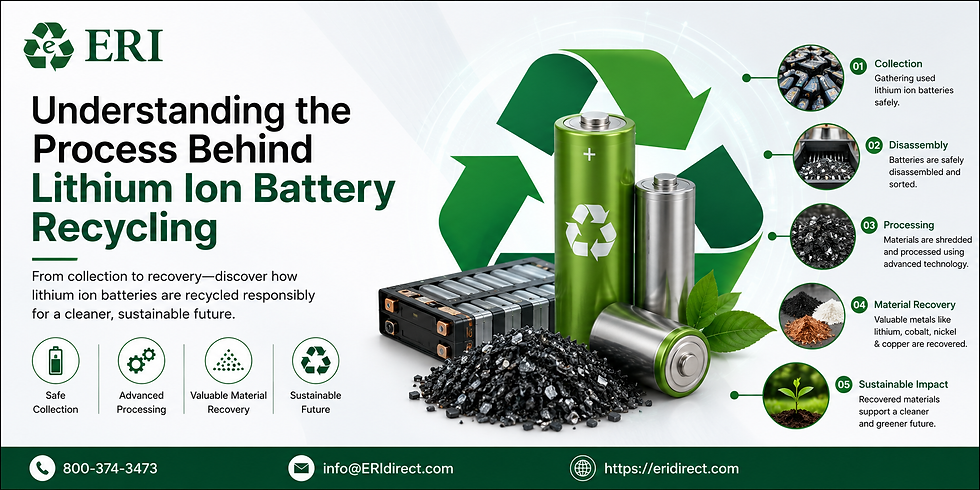
Why Lithium-Ion Batteries Require Special Handling
A battery contains valuable metals and components that can usually be recycled and reused. On the other hand, damaged or improperly disposed batteries can pose environmental and safety concerns.
Batteries continue storing energy after use
Most of the people are not aware about the battery dispose. When a battery appears to be dead, it may still contain some residual energy.
That residual energy can generate fire hazards. If batteries are smashed, punctured or subjected to improper disposal conditions. This is why recycling plants have very strict procedures on handling before starting the processing.
Growing demand increases recycling importance
Nowadays, rechargeable batteries power everything from smartphones to electric vehicles. Increased battery production also increases the need for efficient lithium ion battery recycling services. That helps to manage increasing volumes safely and responsibly.
That's the big picture on lithium-ion batteries , and how rechargeable battery technology became mainstream in consumer and industrial use . Learn more here:
Comprehension of how these batteries are made goes some way to explain why recycling processes have become increasingly specialised.
The First Step: Collection and Transportation
The initial step before recycling can begin is to collect the batteries the right way.
This is a more important stage than many people realize, since damaged batteries need to be carefully packed and transported.
Safe storage helps reduce risk
Generally, facilities will sort batteries by type, condition and chemistry. Before going through the recycling process.
Proper storage helps minimize the risk of overheating, short circuits or accidents in transport. Safety is still a big focus even at this early stage.
Businesses generate large battery volumes
Many organizations manage substantial numbers of batteries through:
data centers
manufacturing facilities
medical equipment
consumer electronics programs
corporate technology upgrades
Instead of trying to dispose of them on their own, they often turn to professional lithium ion battery recycling services.
Sorting and Evaluation Comes Next
Upon arrival at a recycling facility, batteries usually undergo a process of inspection and sorting.
Not all batteries that come to a facility are the same. Different chemistries, different sizes, different conditions need to be treated differently.
Identification improves efficiency
Technicians assess the batteries to determine what to do with them.
Certain units may be suitable for component recovery. Depending on condition and composition, others may require more specialized treatment.
Sorting is the way to maximize material recovery and keep the process safe.
Technology continues improving
Recycling centers today often utilize automated processes. That helps to enhance the efficiency of sorting and simplify the procedure.
Recycling methods continue to adapt as battery technology evolves.
Recovering Valuable Materials
This is often the part people find most interesting.
A key goal of lithium ion battery recycling is to recover materials that would otherwise be lost when disposed of.
Metals can often be reused
Based on the type of battery, the recycling process can recover materials such as:
lithium
cobalt
nickel
copper
aluminum
These materials can be reused in making new products, which means less new raw materials need to be mined.
FAQs
What do lithium ion battery recycling services do?
Professional lithium ion battery recycling services safely and responsibly pick up, transport, sort, process. Also recover materials from spent batteries.
How does battery recycling relate to ewaste recycling?
Batteries are often recycled with electronic waste. So e-waste recycling programs typically work in tandem with battery recycling programs to recover materials and reduce environmental impact .
Conclusion
Most batteries will eventually wear out. But that doesn’t mean the materials inside them are worthless. With modern recycling processes, many of those resources can be recovered, reused and returned to manufacturing supply chains.
That’s why lithium ion battery recycling is becoming more important in a technology driven world. There is an increase in use of batteries, electronics, industrial equipment and electric vehicles. Their responsible recycling will continue. That plays an important factor in driving environmental goals and sustainable resource management.


Comments